
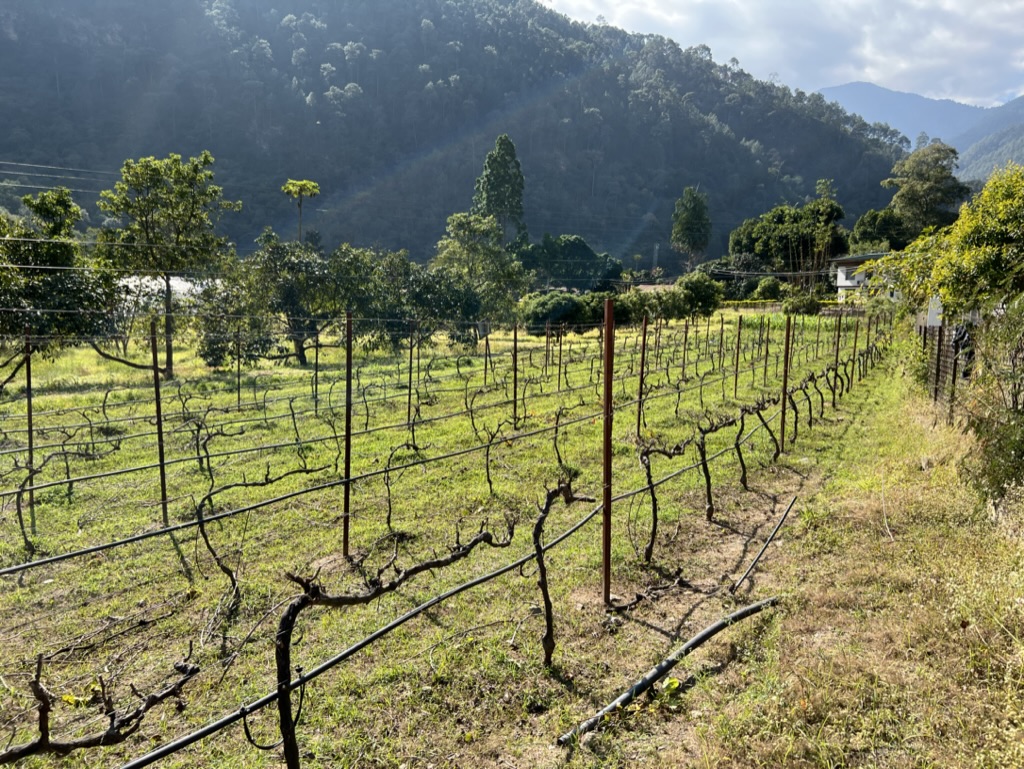
My First Harvest — Bhutan (June – October 2025)
A five-month harvest shaped by altitude and terrain
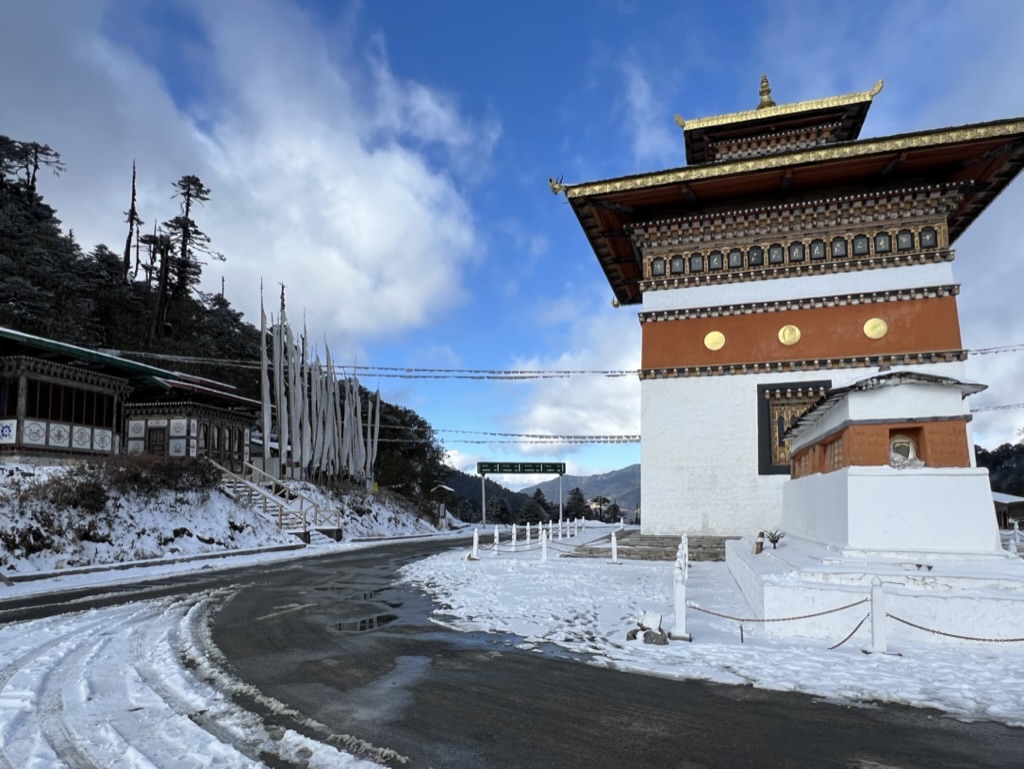
Snowy roads of Bumthang.
It is cold — especially after spending over a month in Southeast Asia. I finish packing and look outside. Snow — ཁཝ — the first I’ve seen in Thimphu. We load up and head to the winery to pick up our fellow pruner and driver. Dorji says he was convinced it would snow today. I tell him it did — just not down here in Babena.
We’re heading east, to Trashigang and Mongar, where our vineyards sit at higher elevations and the days feel longer. We saddle up and cross Dochula Pass. As we climb, a wintry wonderland of snow-covered trees, prayer flags, and sharp turns greets us. Bhutan always amazes me. Just when I think I’ve seen it all, a new layer of beauty unfolds. It’s pruning season, and I’m excited. I’ve never pruned anything in my life. There are still two days of travel before I find out firsthand.
Norzinthang – Trashigang
As our Scorpio bends around the corner, I tap Dorji so he can get a good first look — Norzinthang vineyard, where we will begin pruning tomorrow. It’s mid-afternoon, the sun still up, and the temperature is warm, a welcome change after two days of driving through snow. Our bodies are stiff and tired from the seven-hour drive from Bumthang, and I feel eager to stretch and move.
We unload our gear and begin setting up camp when our host and vineyard manager, Dawa, welcomes us — my tent perched above the vines we’ll prune in the morning. As the sun disappears, so does the heat. I warm myself by the campfire with the vineyard workers, unwinding from the day by scrolling and chatting. Our driver, Kezang, becomes our chef, preparing a nourishing, deeply satisfying meal to ease us toward sleep. I walk past the rows of vines and settle into my tent, wondering what tomorrow’s pruning will be like.
I wake up warm from my best sleep of 2026. When I remove the covers, the cold hits immediately. I open my tent to find the sun already up, though not yet casting its warmth across the vineyard before me.
I prepare my body through asana, facing the vines I will soon prune. Norzinthang’s distant mango tree becomes my drishti, grounding me through balancing poses. I journal quietly, thinking of my grandmother and my hometown, both feeling close and familiar to the work ahead. Each cut we make creates space for new growth. This is the start of the 2026 vintage.
Scrambled eggs, buttery toast, coffee, and juice prepared by Dawa warm us before work begins. Shears come out, along with coils of string. I watch as loops are made, small lengths cut and tucked into belt loops and pockets for easy access later.
We head down to a row of young vines where we’ll begin. Winemaker Matt speaks as we stand among the two-year-old Grenache, explaining the basics of pruning — how each cut sets the amount of fruit for the season and shapes the vine’s overall structure. He talks about the importance of creating an arch when tying down canes. Dawa names apical dominance without hesitation. I watch as cuts are made and canes are tied to horizontal wire.
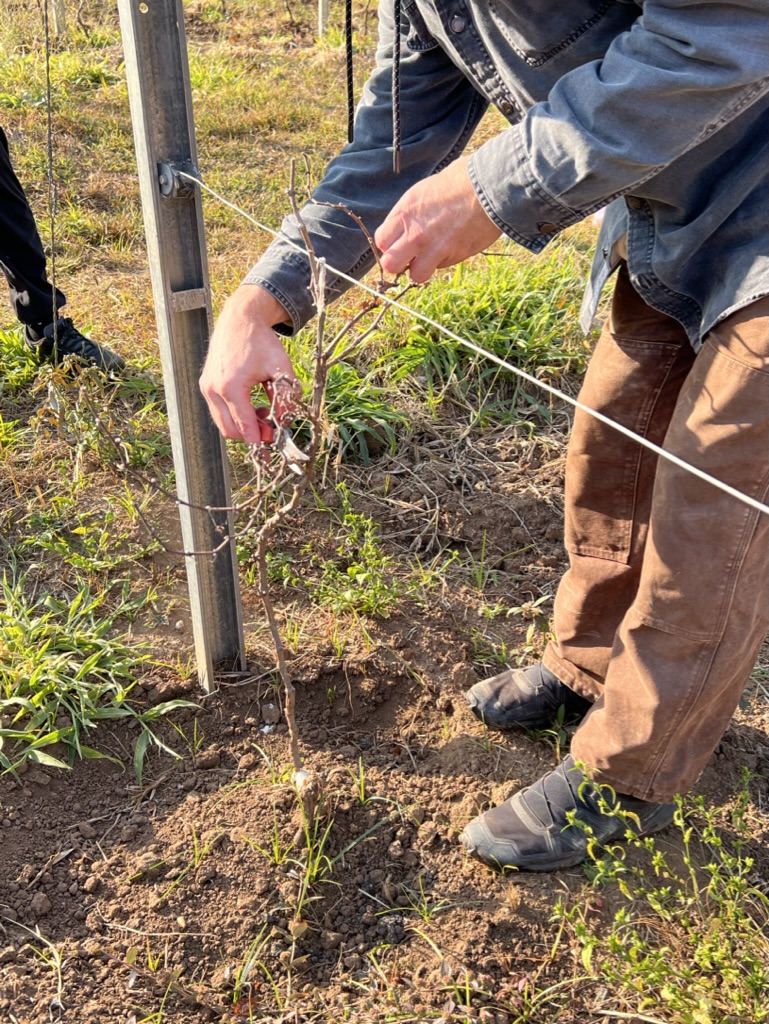
Norzinthang pruning demonstration by Matt.
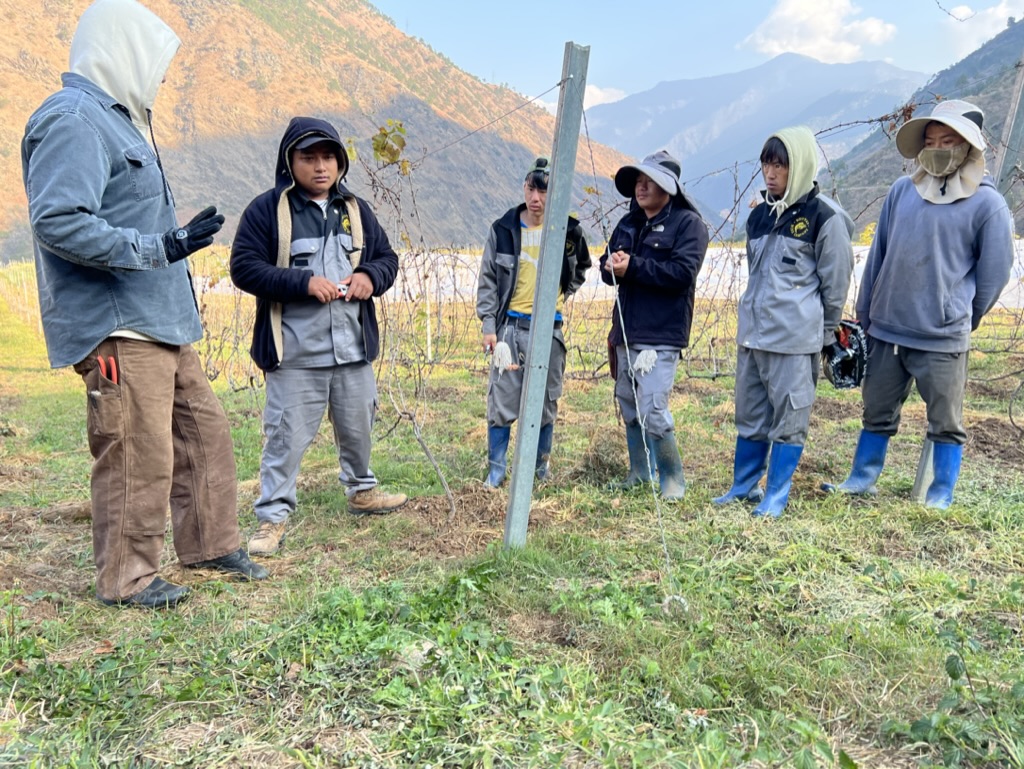
Receiving instructions at Norzinthang – Matt, Dawa, Nima, Karma, Sonam, Sangay.
We’re told to rub the buds off the vine until Dawa interjects. He asks that they be left, so the health of the shoots can be assessed later during shoot thinning, the next stage after pruning. It’s a small decision, but it changes what comes next.
We pair off, experienced pruners working alongside those with less experience. My first partner smiles shyly when I speak to him in English, so I work instead with Dawa. He cuts and explains while I observe and ask questions. I hold my shears against the vine and ask, here? He nods, or suggests an alternative cut.
When Dawa leaves to prepare lunch, I work with Matt. My shears hover as I look for confirmation on the cuts I’m uncertain about. As the sun warms the vineyard, outer layers are stripped off and hung on posts while the work continues. After a while, he moves ahead, leaving vines behind for me to prune on my own.
Lunch is served, and discussions of pruning soon follow. I learn that Norzinthang is among our strongest vines, likely because vegetables once grew here, unlike our other vineyards where the soil is still new. I also learn that in France, a vineyard worker could work for ten years and still not make the cuts we are making. Vineyard pruners are called tailleur de vigne — elsewhere, the names change, but the trust does not.
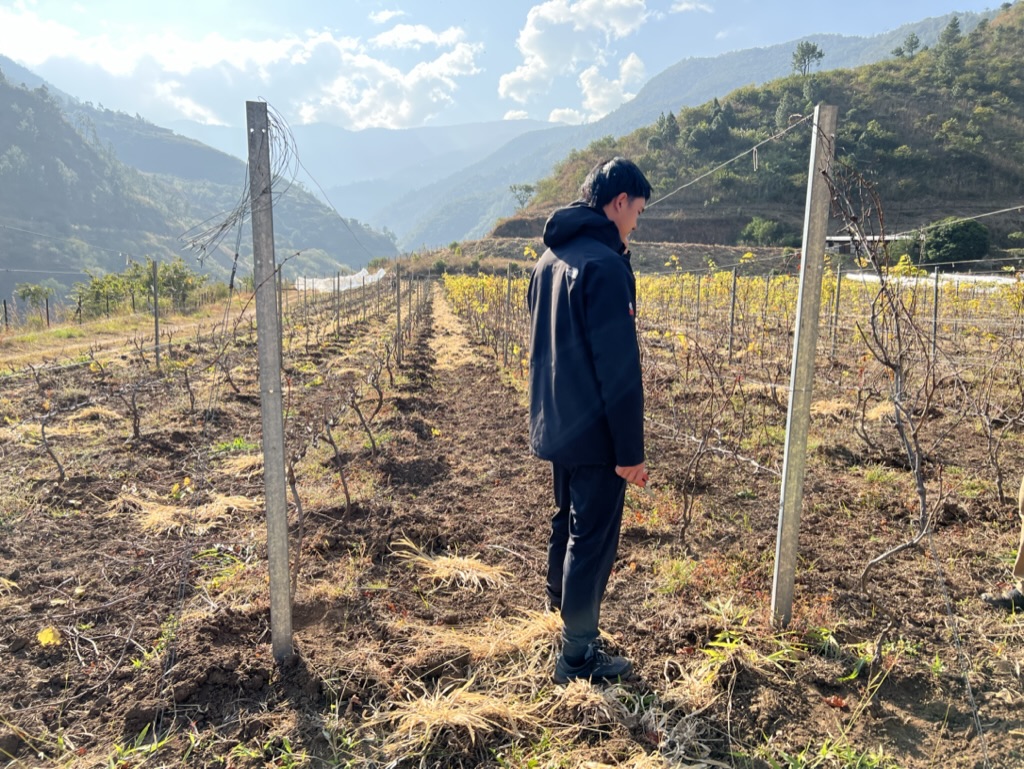
Dorji between vineyards pruned and yet to be pruned – Norzinthang.
There is still a fair amount of work left on the two-year-old vines. Matt is here to lend his expertise to the vineyard team, as well as to Dorji and me, before moving on to the next vineyard and team. After lunch, we move on to the three-year-old Traminette vines. New vines, new strategies.
With the younger vines, the focus is on getting the trunk up to the horizontal wire. With the older vines, the trunks are already there, arms established, shoots emerging. We’re told that an ideal arm has shoots spaced a hand’s length apart. When it doesn’t, it may be better to cut the arm back and tie down a new cane to replace it.
This is where my role shifts again. I work alongside Dawa and Dorji as they make the more decisive cuts near the arms. I watch closely, helping to clear away shoots and leaves from above, learning by assisting rather than deciding.
After the first day of pruning, bottles come out around the campfire. We taste wines, including the first commercial red wine produced in the country, the same one that went to auction in April 2025. The vines behind us are unfinished. The wine in our glasses is still becoming.
The following morning, we return to the work. We warm up on the young Grenache vines before moving back to the three-year-old Traminette. I continue clearing shoots and leaves from above, throwing thicker canes into the center of the rows for propagation. At some point, the person I’m working with moves on, and I’m left on my own. I begin pre-pruning, removing the tops of the vines to make space for the more decisive cuts that will come later.
After lunch, I pack up my campsite. We’ll be staying in a hotel that night before moving on to GorTshalu the following day. While the others start a new row, I return to the Traminette, moving quickly through the pre-pruning, cutting and clearing, intent on movement, on seeing progress. I cut my finger. I raise it above my head to stop the bleeding and keep working. Dorji comes to tell me the day’s work is finished, and I stop.
GorTshalu – Mongar
The next morning, we leave the hotel and drive past Norzinthang, about half an hour down the road to GorTshalu. My finger is still cut and needs protection for the day’s work. With no first aid kit in sight, I sit down and bandage it with toilet paper, electrical tape, and a glove.
That’s when I meet the new vineyard puppy. He climbs into my lap, offering licks and clumsy affection — the best first aid I could have hoped for in that moment. His name is Blackie. From one Blackie to another, no explanation necessary.
We head to the rocky slope where the Tempranillo is planted — real ankle-breaker terrain if you’re not careful. The shoots are long and tangled, twisting into one another like my own curls after weeks of neglect. The vineyard team here is smaller: just three workers, plus Matt, Dorji, and me. Six of us spread across the slope. As we listen to instructions and begin work, we can hear Blackie yapping above us.
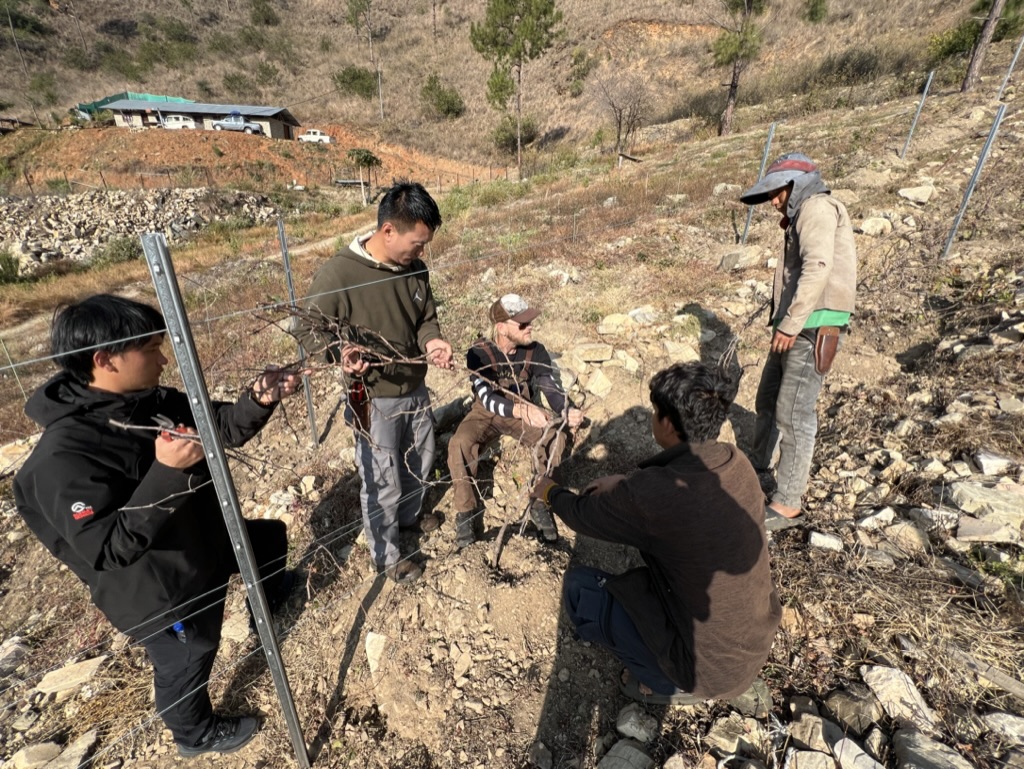
Rocky Tempranillo slope at GorTshalu – Dorji, Namgay, Matt, Rinchen, Choki.
That morning, I work alongside Dorji and vineyard manager Namgay. We traverse the rocky incline one vine at a time, careful of the unstable rocks. Conversations unfold in Dzongkha, leaving me a silent observer. Namgay and Dorji make the more decisive cuts below while I clear away the tangled shoots above.
I begin cutting at the entwined shoots to release them, the way I did at Norzinthang. Namgay asks me to keep the shoots as long as possible so they can be sent south to our vineyard in Gelephu for propagation. I realize these Tempranillo shoots are thicker than the Traminette ones I pre-pruned at Norzinthang. I adjust my practice, and the work continues.
With each vine, my confidence grows. I begin to offer suggestions, discussing possibilities before cuts are made and canes tied down. When Dorji leaves, I’m left working alongside Namgay. We move up the hill to the next row, and he turns to me and says, “Your turn.” I kneel, study the vine, and decide on a course of action. I share my thinking with Namgay, and together we carry it out.
We break for lunch — cheese and egg sandwiches packed by the hotel. After eating, I step away and sit alone in the sun, looking out over the vineyard. When it’s time to return to work, we move to the Cabernet Sauvignon rows, this time on flat ground. I continue working with Dorji and Namgay, asking fewer questions, doing more.
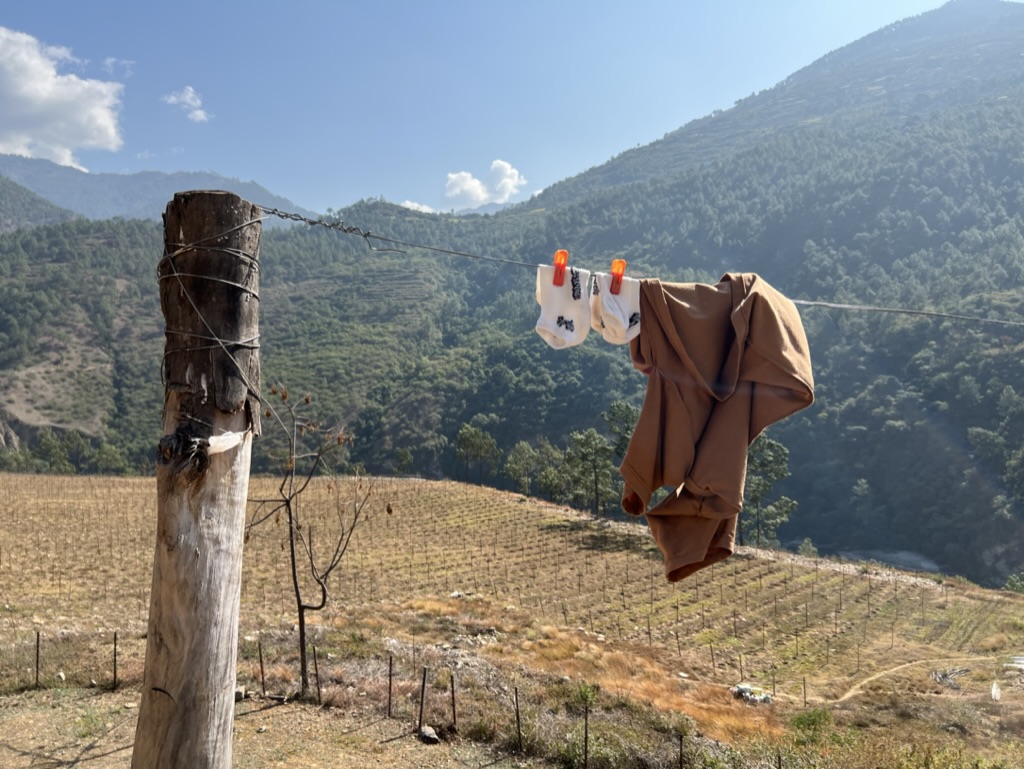
GorTshalu vineyard view, clothes line.
Before long, it’s just Dorji and me. I manage tying down canes with one gloved hand, slower at first, then more easily. We work and talk as we go. He tells me he could never marry a chilup — ཕྱི་ལོག་པ་ — a foreigner, he says, because he would be overpowered. I tell him I don’t like being called “ma’am,” that it makes me feel old, that even my mother doesn’t like it. He agrees to call me Ms. instead.
The work winds down and bottles come out again. We taste wines with the vineyard workers — a chance to drink what they’re working toward. Blackie darts around our feet, full of energy, impossible to ignore. We say our goodbyes, climb back into the Scorpio, and head toward the hotel.
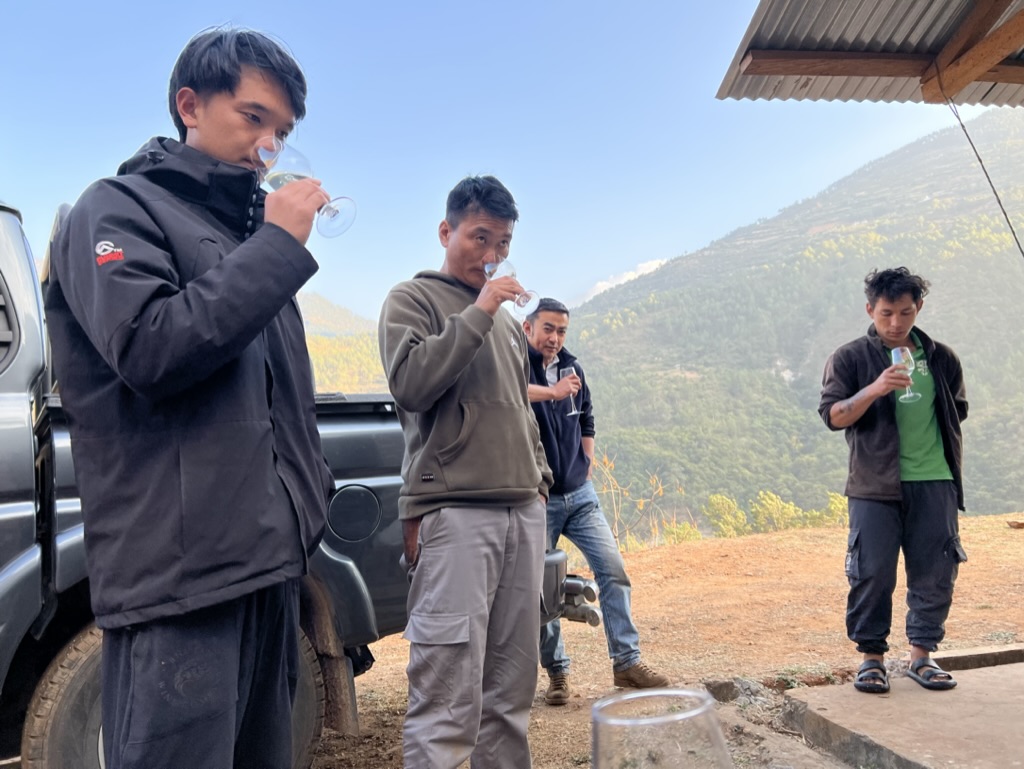
GorTshalu vineyard wine tasting – Dorji, Namgay, Kezang, Choki.
Lingmethang – Mongar
We rise earlier than usual the next morning. It’s a full day — a long drive west and pruning the final eastern vineyard of the trip, Lingmethang. Nearly three hours later, we arrive at the Agricultural Research and Development Sub-Center where this small vineyard sits. Teams from both Norzinthang and GorTshalu are already there to help.
These vines were planted in either 2019 or 2020, making them some of the first vines planted in Bhutan. With older vines come thick arms — the thickest I’ve seen. Some of the shears we have aren’t fit to cut them, and the ones that are require us to twist them up and down the arm repeatedly to make a clean cut. We really should have brought a saw. A good sight — both teams in uniform, working together.
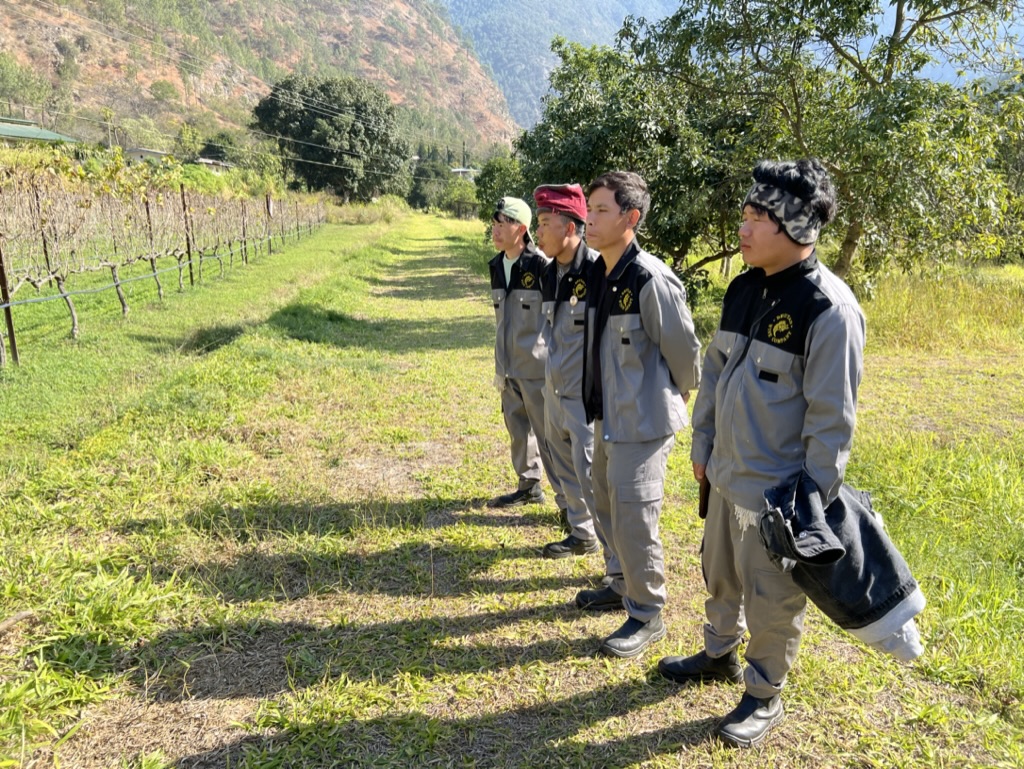
Vineyard workers from Norzinthang and GorTshalu awaiting instruction at Lingmethang – Nima, Rinchen, Sharab, Karma.
I’ve got the stronger shears and successfully cut one of those thick arms. Namgay looks at me and says, “Strong,” to which I reply, “Of course, I’m a woman.” Sudden explosives from a nearby military base startle the teams. It wasn’t the sound that scared me – it was their reaction. With not many vines and a full team at work, we finish pruning and the teams collect the fallen shoots for propagation.
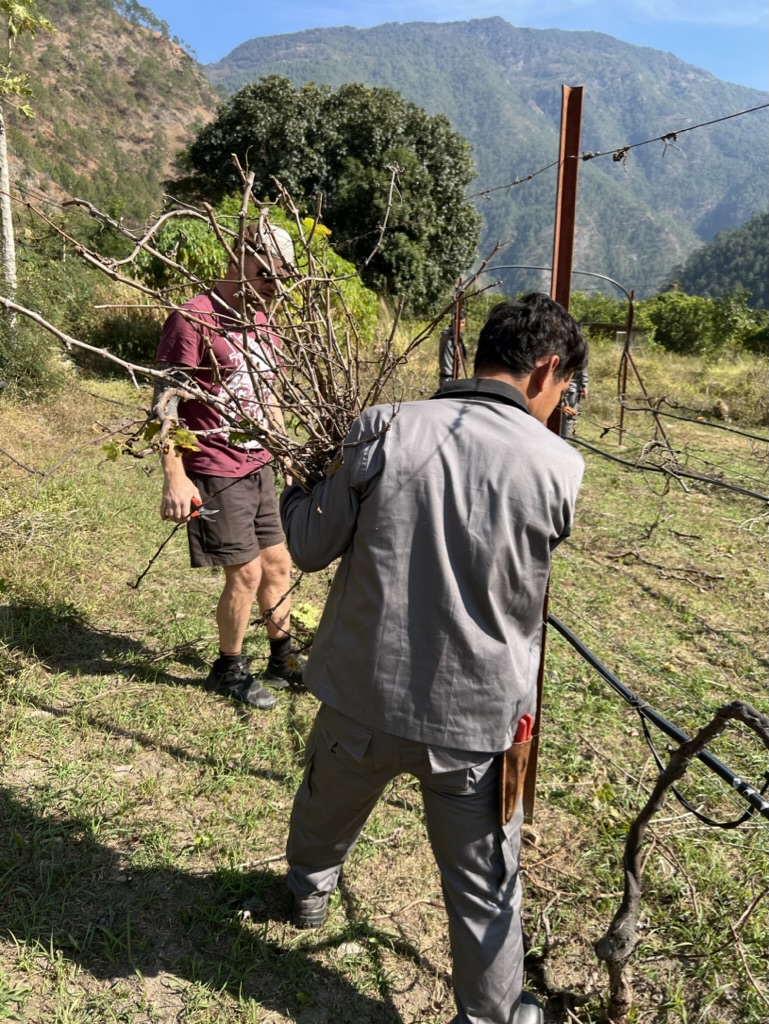
Collecting pruned shoots for propagation at Lingmethang – Choki
Before we leave, I give Namgay and Dawa packs of dried mangoes brought back from the Philippines — another beautiful country, different terrain, shared care. We say our goodbyes. There is still a long drive ahead.
Listening Notes
Music carried us between vineyards and through the work — steady enough for long drives, patient enough for repetition. I usually play DJ on these trips. This time, the playlists shifted, shaped by where we were and who I was with. South Asian music found its way in — Dorji noticed, saying it was the first time he’d heard me play a song in Hindi.
On the road
- Kiwanuka / Michael Kiwanuka
- Untitled (Black Is) / SAULT
- Vulture Prince / Arooj Aftab
- Sometime I Wish I Were an Eagle / Bill Callahan
- Woman / Rhye
- MTV Unplugged in New York – Live / Nirvana
- Love Trap / Susheela Raman
- Sketches of Darjeeling / Bipul Chettri
- Love Deluxe / Sade
- Face Your Fear / Curtis Harding
In the vineyard
- Lamjunge Dadaima Hawa Sarara (Blues)- Single / AI Cores Music
- Nima Yoezer played this from his phone while we worked and was kind enough to share it with me for this piece.
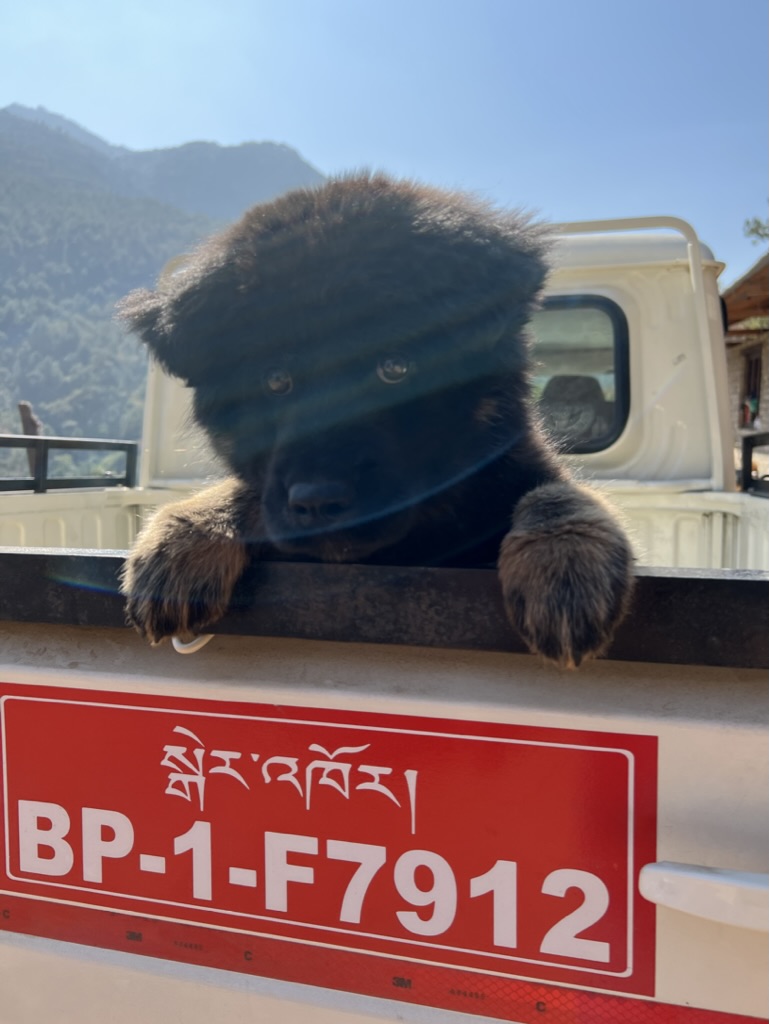
Blackie, GorTshalu’s Vineyard Puppy.
If you’d like to receive new posts when they’re published, you can leave your email here.
A question for you…
As I keep learning alongside Bhutan’s emerging wine industry, I’m curious what you’d like to hear more about.
Vineyards, winemaking, daily life, food pairings — or something else entirely?
You’re welcome to share your thoughts in the comments below, or write to me directly at meka@bhutanwine.com.
 Wine & Bhutan
Leave a comment